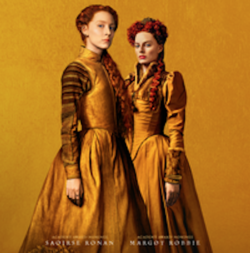

I was since the beginning not that keen to watch this movie, for a fairly good reason. Having researched the historical period and the family Mary belonged to (the Guise) for a long time, I was always unhappy with the way Mary Stuart has been portrayed in fiction -generally as a martyr (which she was not) or a lustful idiot that made all the possible blunders a sovereign could do. To be fair, this is not entirely the fault of the writers/movie directors either: there are few characters in history that have polarised the opinions both of contemporaries and the posterity like her.
But being stuck for 12 hours on a plane works miracle; at the end I relented, and here’s my review. The movie, by Josie Rourke, is (loosely) based on the biography of Mary Stuart by the British historian John Guy, and it has its moments. But you can only appreciate it if you take it as what it is: a work of fantasy, not historical fiction. Not now that the kinds of Hilary Mantel (and her work on Thomas Cromwell) have set such as a high benchmark in terms of historical accuracy and political intrigues.

There are simply too many things that the movie portrays in a wrong or inaccurate way, starting from the way the two Queens looked at each other to the fact that their fateful meeting towards the end never took place in reality: Mary and Elizabeth never met in person. I also didn’t like the way Elizabeth is presented -as a woman more concerned with her own femininity (or lack of) than with the complicated political situation the return of Mary to Scotland constituted for her -a challenge to the English throne. Elizabeth was so much smarter than the character in the movie, even though Margot Robbie got nominated for a BAFTA Award for Best Actress in a Supporting Role, which she deserved. New York Magazine’s Emily Yoshida summarises it well on her scathing review: “After the birth of Mary’s son, James, we’re presented with the side-by-side imagery of a blissful Mary surrounded by bloody afterbirth, and Elizabeth surrounded with red paper curlicues. No matter that we’ve seen James conceived more or less via rape by an angry, drunken, Darnley — Mary had a baby, objectively the greatest joy a woman can know. It’s these bizarre, ahistorical reads married with the intermittent stabs at a boardroom’s idea of millennial values that render Mary a kind of nothing of a film. It’s neither a rigorous history lesson nor a particularly interesting work of drama and character, and it ends up doing the exact same things — pitting women against each other, fixating on fertility and virginity — it claims to find so oppressive for its heroine.” (Read it all here).
So I can’t really recommend it -unless you are, like me, on a long-haul flight and you’ve run out of everything else watchable. But be ready to be disappointed. For more on Mary Stuart, the real historical character, this is a good, easy start. For more, just get in touch.


Leave a Reply