
One thing I always wondered is how the sky looks when observed from another planet; and as a matter of fact, only in few cases we know how it does for real, even though simulations give us a fair idea. I am going to cover this topic in more technical details in future posts, since it’s quite important for worldbuilding and SF. For the moment, I will post here some images.
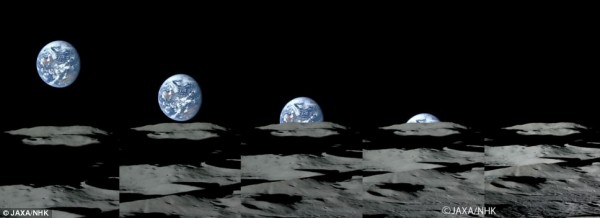
Let’s start with the Moon and the most prized of the views from there, the one of our planet. What we can see from our satellite is amazing, even though Earthrises – like the one in this sets of pictures – would be a bit more complicated to watch, contrary to what the Japanese spacecraft Kaguya, which has taken it, might let us imagine.

This is because, in reality, the probe was in polar orbit around the Moon, not on the Moon itself. In general, an Earthrise cannot be viewed from the surface of the Moon itself, simply because one side of the Moon is locked facing the Earth and the other permanently away (the far side), so Earth stays fixed in the Moon’s sky. The exception would probably be standing on a place between the near and far side, as Emily Lakdawalla explained on her blog. “Now, imagine that you live at a point on the Moon that is on the border between the nearside and the farside. Because of this longitudinal nodding, you would actually see an Earthrise and an Earthset once a month, with the Earth making a loop around its average position in the sky. Resonant orbits make for neat stuff in the night sky.”
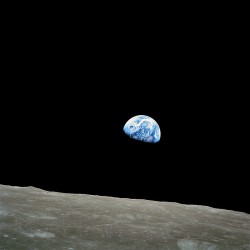
Even from a spacecraft, however, a moonshot is all but a simple stuff, as the technical descriptions from NASA of the Moon’s pictures proves. The most famous of them is, of course, the one from Apollo 8 in 1968, but it was not the first.
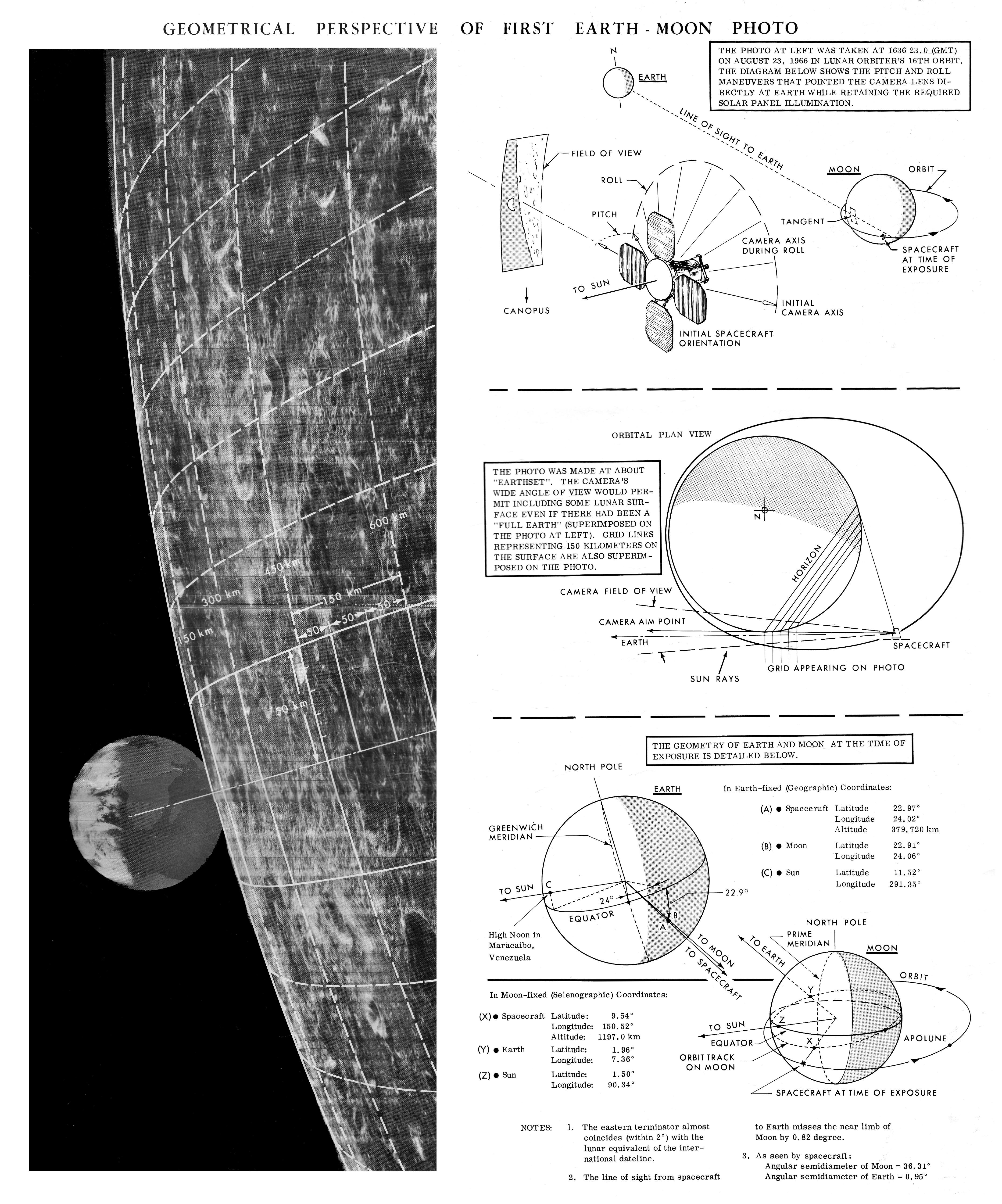
“On August 23, 1966, Lunar Orbiter 1 took the first photo of Earth as seen from lunar orbit. While a remarkable image at the time, the full resolution of the image was never retrieved from the data stored from the mission. In 2008, this earthrise image was restored by the Lunar Orbiter Image Recovery Project at NASA Ames Research Center. They obtained the original data tapes from the mission (the last surviving set) and restored original FR-900 tape drives to operational condition using both 60s era parts and modern electronics.” (The Planetary Society)
Not many, however, beat the full movie by the Kaguya mentioned above, and that you can admire below. Happy watching!

Leave a Reply