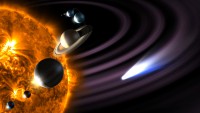

After having published a list of Wonders of the Solar System, it seems just right setting up an entry in the Media Gallery with some of them – namely, moons. NASA is obviously the richest repository, and most of the items come from its archives, but also other sites – like Chandra, ESA and the Japanese Space Agency – are featured here. Enjoy!

I have already given space to charming Saturn’s moons, especially Titan, in a previous post. Here some cool stuff about Saturn’s other moons, then. Enceladus one of the prettiest, with its geysers.


Keeping at Saturn….


While Mimas looks a bit like the Death Star because of the giant impact that created the Herschel crater (130 kilometres), Iapetus is even weirder, divided as it is in two areas one shining white and the other pitch black. What a perfect setting for a story!
A near-alignment of four of Saturn’s restless moons (Titan, Dione, Telesto and Prometheus), courtesy of Cassini. Can you spot all of them?

Jupiter’s moons are sort of cool, too: Io is a living hell, with an intense volcanic activity that looks so pretty on pictures.


How many moons there are in the Solar System, anyway? Impossible to reply – because it depends on how you define a moon. There’s a fierce debate about it, but if we want to keep just at bodies that have been named, in this case we are about 170, give or take.
Out of curiosity, the biggest moon is Jupiter’s Ganymede – actually bigger than a planet (Mercury) and around 3 times the mass of our Moon, that, incidentally, is not a small one either. It means that if Ganymede escaped from Jupiter and instead orbited the sun, it would definitively qualify as a planet – NASA confirms. Unsurprisingly given its dimensions, a thin oxygen atmosphere has been detected on this moon, but NASA believes it is too thin to be able to support life.

While Saturn and Jupiter certainly sport the most varied collection of moons – around Saturn Cassini has counted more than 60, not considering the temporary ones – other planets present fancy stuff too. I have already mentioned beautiful (and doomed) Triton in the Wonder List. Here some others that deserve a mention:


You enjoyed this gallery? Well, do watch this video, from Toptenz, which reports some funny facts about them.
http://www.youtube.com/watch?v=XMLKB4uHPi4
Leave a Reply