
I have read some days ago a nice article on IO9 discussing the Seven Wonders of the Solar System – from the original Seven Wonders of the Ancient World of which only the Great Pyramid of Giza remains standing. Whilst I disagree with some of the choices, I got the inspiration for writing my own List of Wonders, also explaining the reasons why those specific objects have been chosen.

THE EARTHIAN HIVEMIND’S WONDER LIST OF THE SOLAR SYSTEM
1. Let’s start with the most obvious, the one object that would make it into any list, no matter how smug the writer: SATURN’S RINGS, that spell wonders since Galileo observed them in 1610 with his telescope (without realising their nature though. It was Christiaan Huygens, in 1655, the very first to describe them as a disk). They are not the only, but certainly the most extensive planetary ring system of any planet, made by countless small particles, whose size varies from micrometres to metres, and made almost entirely of water ice, with some small components of rocky material. For some really cool pics, check this out in the media gallery.

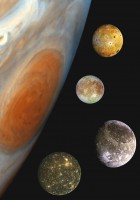
2. The BIG RED SPOT of Jupiter, also dubbed as “the biggest storm of the Solar System”, and so famous it has been featured everywhere. But hey, the bad news is that it has been shrinking since a while. Do we have to kiss it goodbye? Not anytime soon: astronomers have followed it downsizing since the 1930s, so we can expect to have it around for some more time.

3. Remaining in the surroundings, EUROPA, one of the Galilean moons of Jupiter, is an object that has recently attract a lot of attention, and even plans of human exploration. NASA has just put in a budget request – around 25 US$ million – for an unmanned mission in 2023. Why so? Why not, I would rather say. Yes, because this icy world roughly the size of our Moon has plenty of intriguing features. First of all, it has geysers – spotted in 2013 by Hubble telescope, in the form of plumes of liquid on the surface.Their recent, sudden disappearance has just invited more scrutiny, if any.

Even more interesting, it is so far the only celestial body to share with Earth a key feature for the development of life conditions, namely plate tectonics and a surface-shifting geological activity of some kind. Finally, there are good hints Europa has a global ocean of water in contact with a rocky seafloor, containing almost twice as much water as on our planet and kept liquid by the gravitational pull of Jupiter. With all this, it’s not surprising it is considered the most suitable candidate for extraterrestrial life. You don’t believe it? Just watch this:
4. Another moon-wonder is TITAN, the biggest of Saturn’s moons, tidally locked by gravity so that the same side always faces toward Saturn. What’s so special about it to deserve its inclusion in this list? Well, it looks beautiful in Cassini-Huygens’s imagery (not joking: it does, really). But there are more robust scientific reasons. It has a dense atmosphere, that looks like a golden haze and makes difficult observing its surface. And lakes and oceans, just like Earth, with the only difference that its seas are made of methane and not of water. Now, there have recently been a lot of speculations about the use of methane, instead of water, as hint for alien life. Thus pretty Titan seems to be another good candidate for life (as in the case of Europa, not necessarily intelligent, but some kind of microbes that can survive in those extreme environments).

A curiosity: if J.R.R. Tolkien had a celestial body, this would be the one: Titan’s mountains are named after The Lord of the Rings, and yes, Mount Doom (Doom Mons) is the highest peak over there.
5. PLUTO, the planet that never was. First discovered in 1930, it got the status of solar system’s ninth planet before being demoted and reclassified as a dwarf planet, due to the presence of similar objects in the Kuiper Belt. Discussions are still ongoing about its planetary state, though. New Horizons will most likely help scientists make their mind about it, by providing for the first time ever direct imagery from an orbiting vessel (maybe I should have put New Horizons itself on this list. But it’s man-made, so it doesn’t qualify for natural wonders).

New Horizons closest approach to Pluto will be at 7:49:59 a.m. EDT (11:49:59 UTC) on July 14, 2015 – in around 300 days or so, but it will begin data transmission well before that moment. It has as already started. Waiting for the full set, you can have a look at imagery from the Hubble Telescope, so far the most accurate in our possession:
NASA HUBBLE SPACE TELESCOPE – Rotating Pluto Animation
6. The KUIPER BELT & the OORT CLOUD, where all comets come from. The now-famous 67P/Churyumov–Gerasimenko comet, visited in these days by the ESA-Rosetta spacecraft, can be considered a good ambassador of this far-away population. To be precise, the Kuiper Belt extends from about 30 to 55 AU and it is full of hundreds of thousands of icy bodies larger than 100 km across and an estimated trillion or more comets. The Oort Cloud lies farther away and it contains an even wider swarm of objects, around 0.1 to 2 trillion icy bodies. Both remnants from the formation of the solar system about 4.6 billion years ago, objects in the outer region of the Oort Cloud also resent of the gravitational influence of nearby stars.

7. For the seventh and last one, I have chosen a wonder that will be no more… in time. This seems just right, considered the fate of the Seven Wonders on our Earth. The doomed one is poor TRITON, the largest of Neptune’s moons, rather unusual because it’s the only large moon in our solar system with a retrograde orbit. Scientists believe Triton is actually a Kuiper Belt Object captured by Neptune’s gravity millions of years ago.

More worryingly, Triton’s orbit is a decaying one. It will eventually approach Neptune’s Roche limit and will be torn apart by tidal forces, leaving behind a brand-new set of sparkling, icy rings. Another pure wonder in the making.

I would be very interested in having some feedback on this list. Any other object that should have deserved a place? Let me know!


Leave a Reply