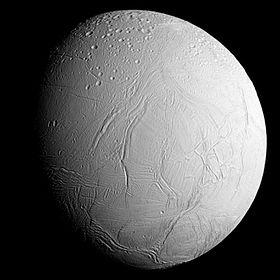

I have already written about Enceladus in the past – a frozen world orbiting Saturn and one of the most likely to support life as we conceive it on Earth. Now it seems scientists were right in their assumption: NASA has recently released evidence that a liquid water ocean that could support life has been found beneath the moon’s frosty surface – as in Jupiter’s Europa.
 “Confirmation that the chemical energy for life exists within the ocean of a small moon of Saturn is an important milestone in our search for habitable worlds beyond Earth. We now know that Enceladus has almost all of the ingredients you would need to support life as we know it on Earth.” (NASA Press Release).
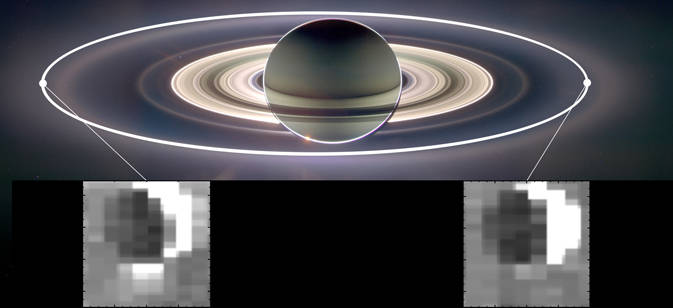
Moreover, a recent paper appeared on Science (April 2017) reports on the latest NASA’s findings. Here’s the abstract: “Saturn’s moon Enceladus has a subsurface ocean covered by a layer of ice. Some liquid escapes into space through cracks in the ice, which is the source of one of Saturn’s rings. In October 2015, the Cassini spacecraft flew directly through the plume of escaping material and sampled its chemical composition. Waite et al. found that the plume contains molecular hydrogen, H2, a sign that the water in Enceladus’ ocean is reacting with rocks through hydrothermal processes (see the Perspective by Seewald). This drives the ocean out of chemical equilibrium, in a similar way to water around Earth’s hydrothermal vents, potentially providing a source of chemical energy.” (Full paper is available here).
Stunning images of Enceladus can be retrieved from NASA’s Cassini archive, and this is an interesting video discussing alien life on that moon. Enjoy!


Leave a Reply