
I have already written some time ago about tools for exploring the night sky and find your way around. Today I want to talk about another one I have been recently using, this time for worldbuilding in SF, but that can easily used for the first purpose too. The name is eSky, and it is “a site dedicated to the entire universe. Here you’ll find a whole range of articles covering cosmic phenomena of all kinds, ranging from minor craters on the Moon to entire galaxies.” (Note: all quotes in this post come from the official eSky website).
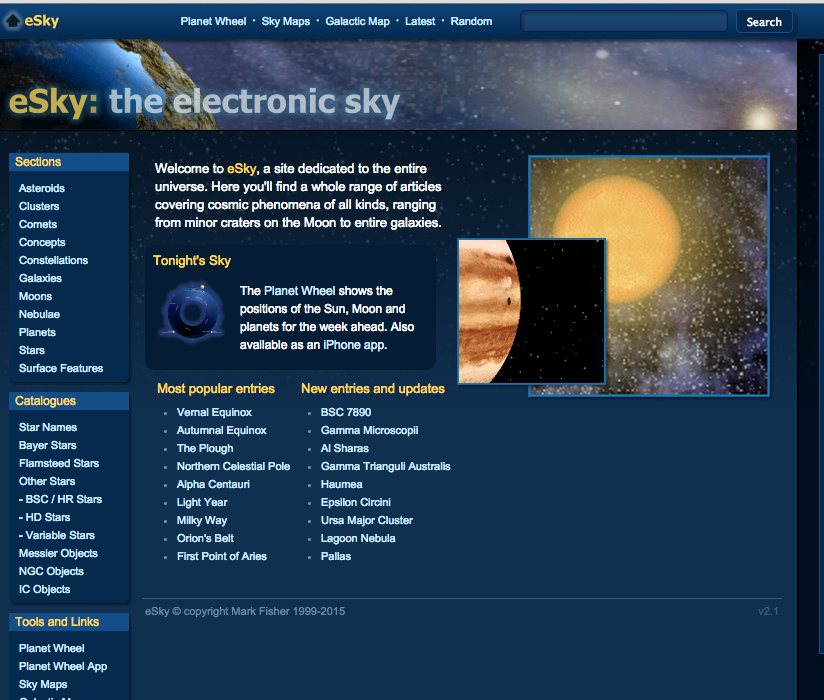
I have to say, after a couple of days of intensive use, that eSky maintains its promises. There are a lot of useful resources, from detailed features of celestial objects of the Solar System to catalogues of stars.
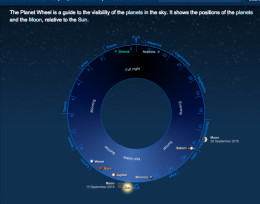
One my favourite features is the Planet Wheel, which is an interactive (read: clickable) guide to the visibility of the planets in the sky. It shows the positions of the planets and the Moon, relative to the Sun. What’s good in that? For example, to use it as a quick reference. “The nearer a planet is to the Sun in the sky, the less visible it becomes, and planets that are very close to the Sun in the sky are only above the horizon during the day, and so cannot be observed at all. So, planets shown in brighter part of the Wheel, near the Sun, are hard or impossible to see. Conversely, planets opposite the Sun on the Wheel are above the horizon for most of the night.”
Another remarkable features are the detailed sky maps, especially one, the Map of the Milky Way.
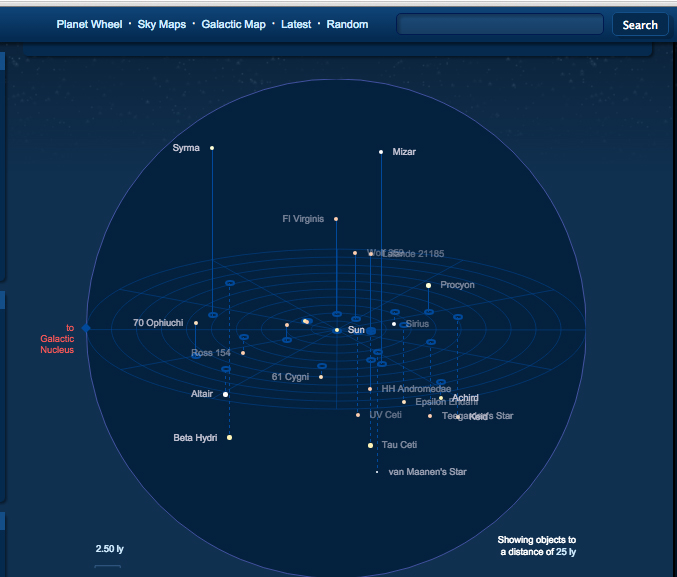
Again, the site description tells it all, describing it as “a three-dimensional view of stars and other bodies, centred on the Sun. You can zoom in or out, or rotate the display, by clicking the Zoom or Rotate buttons beneath the map. At scales greater than about 15,000 light years, the map will show a dashed ellipse, which represents the approximate extent of the Milky Way Galaxy, and the centre of the Galaxy will also be marked.” I found this quite useful, simply because it’s difficult picturing space in three dimensions, being used as we are to see 2D charts. Optical proximity is not actual proximity. And two stars can be 20 LY away from the Solar System, but in opposite directions. It looks trivial, I know, but I found so often inconsistencies in SF stories about similar things that I warmly suggest anybody aiming at writing SF (and not fantasy in space) to check out his/her spatial references and locations before even start writing. Otherwise, do stick to completely fictional stars. But mixing the two is often recipe for disaster.
Enjoy eSky!


Leave a Reply