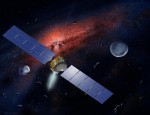

Today March, 6 NASA’s Dawn has finally completed its historic mission and entered Ceres’ orbit after 7.5 year of travel. The first space mission to have reached not one but two previously unexplored (dwarf) planets/asteroids, Dawn has previously studied Ceres’ twin Vesta in 2011 and 2012 before moving on to its next target, the biggest celestial body on the asteroid belt.
CERES VESTA GASPRA

The main objective of Dawn’s mission is to find out more about the early history of the Solar System by exploring the two bodies that have evolved in different ways and that present a quite different look. While Vesta looks similar to inner planets like Mars, Ceres has more in common with Saturn’s icy moons. As NASA explains in detail on the mission’s official webpage, this is not just a voyage in space, but also in time.

“Both Ceres and Vesta, we believe, are proto-planets. They were on their way to forming larger planetary embryos and they were the type of object that merged to form the terrestrial planets.” (Dr. Carol Raymond, Nasa’s Jet Propulsion Laboratory).
A lot is expected from this mission, and Ceres might have a few surprises in store. It is thought to have a liquid ocean under its surface, hinting at some forms of life; water vapour has been detected; and, on Jan. 13 a photo with a mysterious white spot clearly visible has been shot by Dawn, leaving the world puzzled (the spots are actually two at a closer look).

Finally, a few words regarding Dawn’s propulsion, a novelty and an achievement in its own right. Differently from the majority of space missions, whose probes’ engines are powered by chemical reactions, Dawn uses ion engines, i.e. electric fields. The basic difference between the two is that chemical reaction engines are powerful but not very efficient energy-wise whilst spacecrafts like Dawn can travel for years, and cover huge distances, before running out of fuel.
A video about the mission is available here, narrated by the late Leonard Nimoy.
http://www.youtube.com/watch?v=MTfMBJngwtw


Leave a Reply