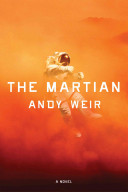

Reviewing The Martian is not an easy task, for a series of reasons. The most important is that there has been a lot of hype around this book, therefore expectations from my side (and from other readers, I guess) were obviously high. This might explain why comments about it have been mixed, ranging from extremely positive to negative. Useless to say, this has just made me more willing to have a go myself.

Now that I am through with it, I can safely say I am on the side of people who have liked this book. More, I have adored it. But I can also affirm I understand well why others might have not enjoyed it: it can be boring, too technical and dull, if you’re not a science buff (and Andy Weir obviously is one. Read this, where he talks about it). But let’s go with order.
The plot is simple, and the title gives it away immediately: an astronaut (a likeable and funny guy called Mark Watney) on a Mars mission (Ares 3) gets stranded and left for dead by his crewmates on the Red Planet. Surprise, surprise, he’s alive, and he tries to find out in all possible ways how to survive until the next mission lands. Ah yes, tiny detail: Ares 4 is due in four-year time, when all his supplies have run out since long. Don’t you find it fascinating? I did, and I read it in three days (er, nights).

One of the things I have especially enjoyed is the way Weir talks about power struggles in NASA, because they seem realistic enough. And the whole Mars experience is amazingly well portrayed. Actually, a fun way to read the book is to plot Watney’s travels on Mars maps, freely available on NASA website. I was lucky: I found out somebody has already done it for me here.
I won’t give away here how the book ends – I don’t like spoilers – and so I will avoid one of the two critical remarks I have about this otherwise great story. I will talk instead about the second one, which is related to the Chinese spacecraft NASA plans to use at a certain point. Weir writes a few pages here about Chinese officials discussing the option. What’s the problem? Well, I am not sure about the exact words two Chinese scientists working in a military-related organisation would have used in that context; but I am positive they would have not talked in that way (after ten years of living and working in East-Asia, mainly in China, you get a certain feeling about the way people think and express themselves). This was more the way an American imagines it. And that’s fine, don’t get me wrong, but it should have been handled, narratively speaking, in a different way. Like that, it simply sounds sort of fake.

One interesting thing to notice about this book is that it was, in origin, self-published by the author in 2011. In 2014, Crown Publishing purchased the rights and re-released it. A good move.
What next? If you have liked, as I did, this amazing story, you may want to read something more about it. Here some links worth having a look. Some other book reviews (a positive one, a less enthusiastic one) and something about how realistic the whole setting is.
And get ready to see it on the big screen. Apparently, Ridley Scott has made a movie on the story, featuring Matt Damon that should be released some time soon. Can’t wait for it.
(Note: I received this book as an ARC from Random House through Netgalley.)


Leave a Reply